
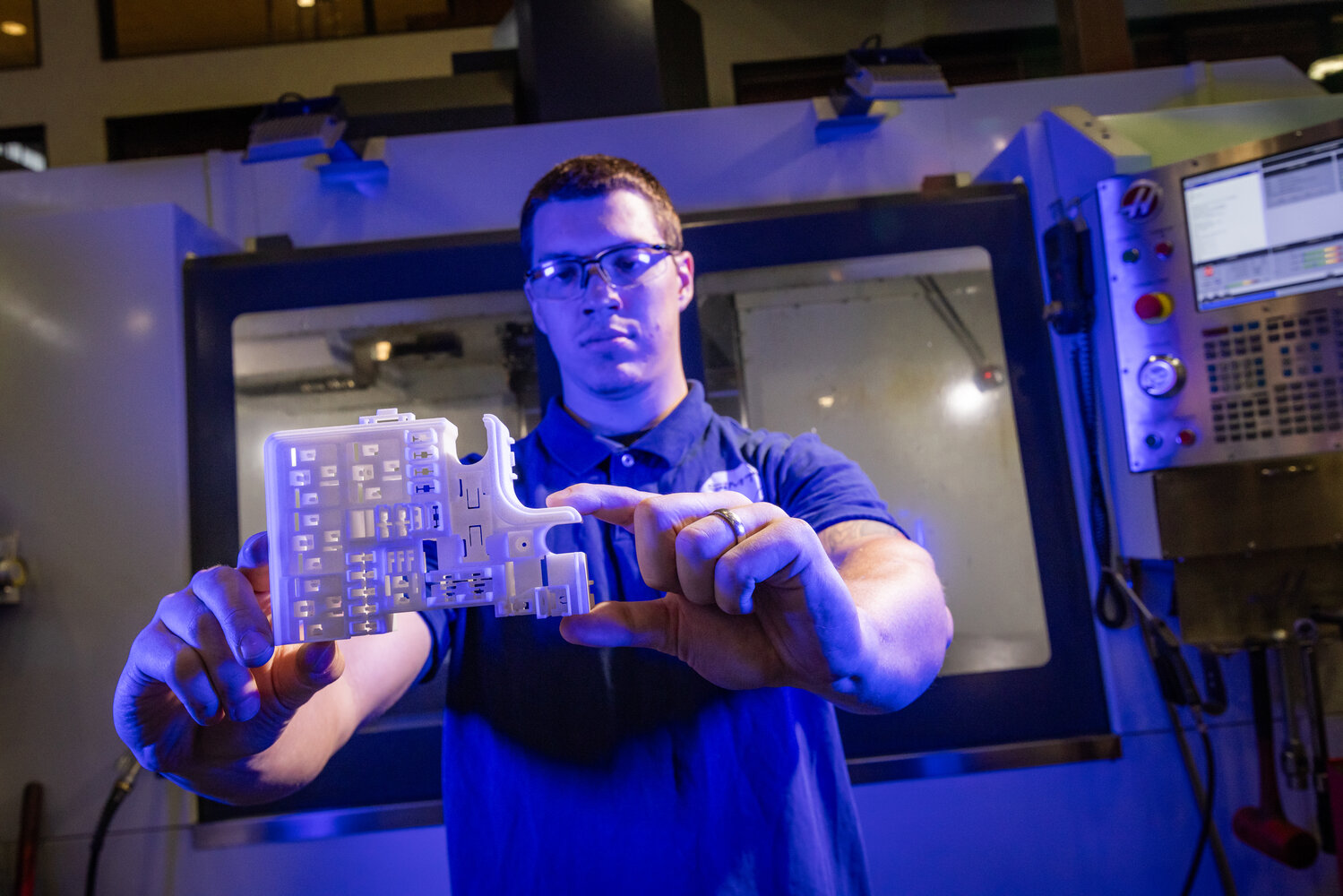


While the term "additive manufacturing" may not be familiar to the average person, some of the products of this new technology are already present in our day-to-day life.
Dental care items like Invisalign and crowns, athletic shoe inserts, hearing aid shells – all are being made using additive manufacturing also known as 3D printing. And in South Carolina, companies like Boeing, BMW, and Volvo USA are regularly using the process as they manufacture planes and automobiles.
While conventional manufacturing typically involved cutting material away to make objects, additive manufacturing uses lightweight layers to create, offering less waste in production.
Used at Boeing's 787 Dreamliner final assembly plant in North Charleston, the company's additive-manufactured contributions include production tools and interior pieces of the aircraft, such as ducts. The airline's research and technology center also explores advancements in "next generation" manufacturing including additive manufacturing and 3D printing.
BMW Group makes tools to aid in auto production using the process at its Spartanburg plant, while at Volvo USA's Ridgeville plant additive manufacturing is used by engineers for various pre-production updates, from test fitting to assembly methods and confirmation of updates on new models of vehicles.
At the forefront of the technology used for 3D printing is 3D Systems, whose founder Chuck Hull invented the process in 1983. In its Rock Hill facility, the company continues to employ additive manufacturing techniques for industries ranging from aerospace/defense to automotive and consumer products. More recently the company has been expanding their range of production to metal and polymer products, supplying global partners including Align Technology (Invisalign dental devices) and NuVasive, who make spinal implants and other orthopedic implements.
Startups making the region a force
Columbia's CADmore Metal has made a splash by bringing Cold Metal Fusion (CMF) to the area after opening in 2024. Serving energy, automotive, aerospace, defense and industrial clients in the Upstate, the company says its technique makes metal parts – including titanium - that are stronger and less expensive to produce.
The process is like earlier 3D printing but adds additional steps to create a fusion of surfaces between the metals and other substances. The company's CEO, John Carrington, has said they expect pricing to go down as the business grows. Operating out of a close to 3,000-square-foot-space currently, they plan an expansion later this year.
At New Forge in Rock Hill, startups are being enabled with access to workspace and 3D printers. A collaboration between European research organization CERN and the state's Site and Civil Engineering Department (SCE), the space opened earlier this year and hopes to help with creating prototypes for visiting students and new businesses in the area looking to use additive-type technology in their manufacturing.
Training and supporting innovative manufacturers
Greenville Technical College's Center for Manufacturing Innovation (CMI) has brought a valuable training and manufacturing resource to the Upstate since its opening in 2016. "The center is not only training students on advanced manufacturing techniques, but it has also been the face for start-up companies to prototype new ideas and provide connections between students and what’s happening in the industry," says Raymond James, interim dean, School of Advanced Manufacturing and Transportation Technology.
The field is growing academically, with Greenville Tech's School of Advanced Manufacturing and Transportation counting over 600 students annually. "A CNC (Computer Numerical Control) certificate program goes beyond traditional three-axis machining to include rapid prototyping with 3D printers and other technologies," James explains. "The college has also invested in additional advanced manufacturing equipment in recent years, including new 3D printers and instructional support equipment at CMI."
Companies are taking notice, he notes. "Employers are looking for personnel who understand how computer-generated designs are turned into physical products, whether through additive or subtractive techniques."
The opening of Clemson University's new Advanced Materials Innovation Complex this year has enriched the state's training ground for additive manufacturing-related fields. The 143,000-square-foot, $130 million facility opened this spring semester and provides modern spaces for undergraduate and graduate research labs as well as shared interdisciplinary space.
The Florence-based Southeastern Institute of Manufacturing and Technology (SiMT), a division of Florence-Darlington Technical College, provides industrial 3D printing/additive manufacturing for various manufacturers as well as training. The state-run facility also offers a start-up business incubator and multi-use commercial spaces for new companies. At Greenville Technical College's Center for Manufacturing Innovation (CMI), students can learn Additive Manufacturing as part of the school's associate degree or bachelor's degree. Additive Manufacturing and 3D Printing is also offered as corporate training and continuing education options.
Statewide, the South Carolina Manufacturing Extension Partnership (SCMEP) serves as a bridge between high-tech additive manufacturing and more conventional manufacturing. The partnership supports businesses with custom, on-site consulting that can help them with incorporating new technologies like additive manufacturing. SCMEP's advisers also work to link manufacturers with workforce training, innovation centers and local resources.
One of those resources is Greenville TPM Inc., whose Additive Manufacturing Lab supports businesses looking to use additive manufacturing to streamline their production. The company offers software, printing, and assistance with applying digital technology.
AIRSYS Cooling Technologies in Woodruff's construction of a $40 million, 264,000-square-foot headquarters is expected to bring over 200 jobs to the area when completed. The company provides cooling solutions for data centers, implementing 3D printing/additive manufacturing as part of their technology.
National organizations that support additive manufacturers include the Society of Manufacturing Engineers (SME) who provide a dedicated Additive Manufacturing Committee for members. Likewise, the Additive Manufacturing Users Group supports members in the field with education, information and networking. The group evolved from a core of founding innovators in the 3D printing/additive manufacturing realm in the 1990s and has expanded to include international members.


Comments
No comments on this item Please log in to comment by clicking here